- You have no items in your shopping cart
- Continue Shopping

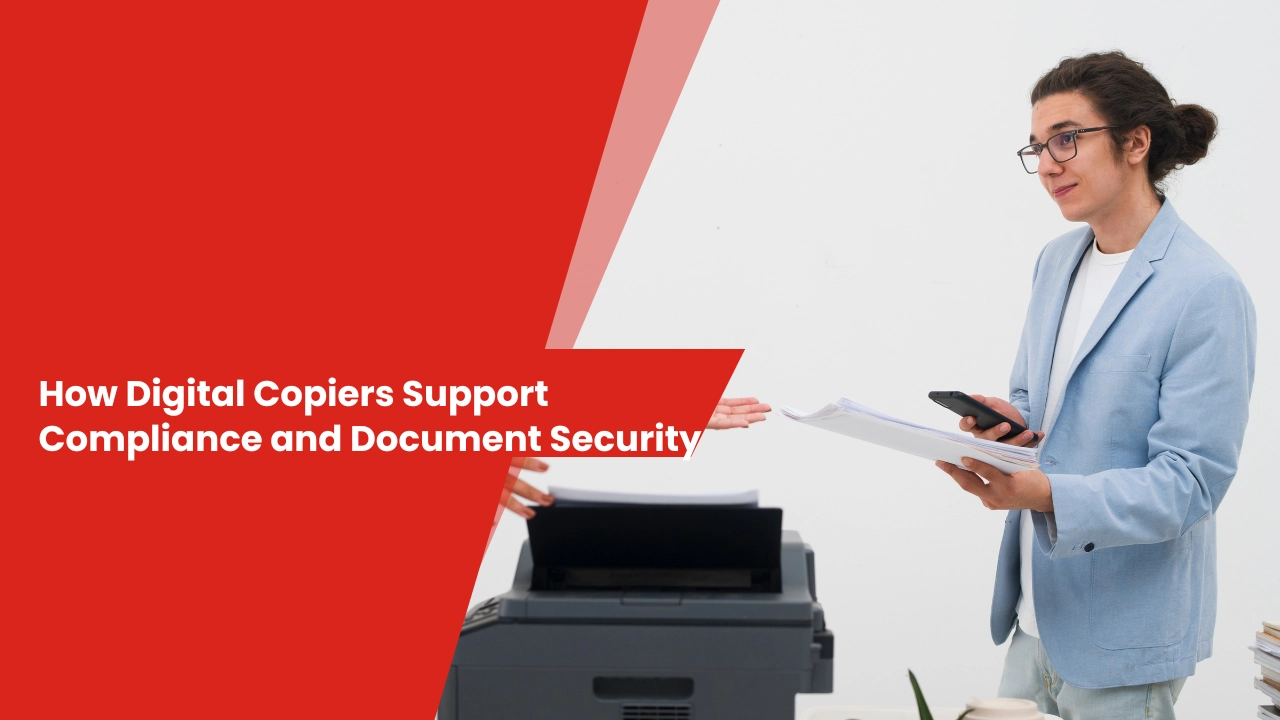
Digital copiers support compliance and document security by controlling access to sensitive documents, encrypting stored data, and maintaining detailed audit trails. When implemented through Digital Copier Services In Abu Dhabi, these systems become a frontline defense against data breaches while helping organizations meet regulatory and operational security requirements.
How Do Digital Copiers Help Organizations Meet Compliance Requirements?
Compliance is no longer just the domain of IT servers or Cloud infrastructure. Digital copiers are significantly integrated within document management, dealing with contracts, employee details, financial, and customer data. Contemporary copiers are designed taking compliance norms into consideration, assisting in ISO 27001, GDPR, and data protection in the UAE.
Capabilities such as authentication, role-based permissions, or secure print release make sure that only approved persons can view secure data. The built-in audit trail can be set up to monitor all activity related to printing, scanning, or copying. This helps meet auditor requirements for compliance truthfully. Yet, one factor leading to breaches is still human mistakes.
What Document Security Risks Do Traditional Printers Create?
Traditional printers and MFPs may come with minimal or no security features. Print jobs may be printed anonymously, and files may be stored on their hard drives without encryption or transmitted through the network without security protection. Such vulnerabilities make confidentiality harder to maintain at the office.
Many organizations are addressing this risk by shifting to managed solutions such as Office rental Printers in UAE, where security updates, monitoring, and policy enforcement are handled centrally. This approach reduces the burden on internal teams while ensuring that document security keeps pace with evolving threats.
How Does Secure Printing Improve Accountability Across Teams?
Secure digital copiers change employee behavior by making document handling intentional rather than casual. Authentication methods like PIN codes, access cards, or biometric verification ensure that documents are released only when the authorized user is physically present at the device.
This accountability discourages unnecessary printing and helps teams handle confidential information more responsibly. For departments like HR, finance, and legal, this level of control significantly lowers the risk of internal data leaks while supporting a culture of compliance.
How Is AI Is Transforming Digital Copiers in 2026?
How AI Is Transforming Digital Copiers in 2026: This extends beyond the realm of automation, moving towards predictive security. Thus, AI-powered copiers are capable of identifying the nature of the documents, pointing out the sensitive information present within, and securing it automatically through encryption or restriction controls. They can also indicate irregular usage patterns, including the printing of confidential documents repeatedly or printing at unorthodox hours.
Instead of reacting to incidents after they occur, organizations gain early warnings and preventive controls. This shift makes digital copiers an active part of the cybersecurity and compliance ecosystem rather than a passive endpoint.
What Is the Future of Office Printing: Predictions for the Next 5 Years?
The Future of Office Printing: Predictions for the Next 5 Years looks towards a future with fewer printers that are more intelligent. With hybrid working on the increase, cloud-linked copiers will ensure security policies are standardized across various sites. There will also be greater automation in regulatory reporting, resulting in faster and more affordable auditing processes.
Printing volumes may decrease, but the importance of secure document output will grow. Businesses will prioritize solutions that combine sustainability, security, and regulatory alignment in a single platform.
Key Takeaway: Secure, AI-enabled digital copiers are no longer optional office equipment; they are strategic compliance tools that protect sensitive information, strengthen accountability, and future-proof document security as regulations and work models continue to evolve.